
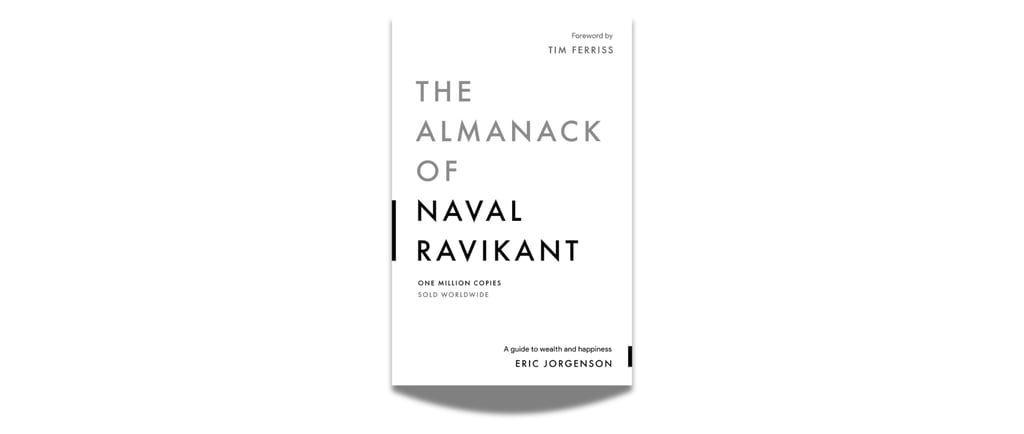
The Almanack of Naval Ravikant by Naval Ravikant
Money is a skill, not a personality trait.
7/23/20264 min read
Wealth is a skill, so is happiness
In The Almanack of Naval Ravikant, Eric Jorgenson pulls together a decade of Naval Ravikant's tweets, essays, and podcast riffs into one blunt argument: making money is not a thing you do, it's a skill you learn. That reframe changes everything. If it's a skill, you can study it. If it's a trait, you're just stuck.
Naval draws a hard line between three words people use interchangeably. Wealth is assets that earn while you sleep. Money is how we move that wealth (and our time) around. Status is your rank in the tribe. Most people spend their twenties chasing status, mistake it for wealth, and wonder why they still feel poor at forty. Wealth is the one that actually buys freedom.
Getting rich, in his telling, comes down to knowing what to do, who to do it with, and when. Hard work is required but not sufficient. You still have to point it in the right direction, and that direction is giving society something it wants but doesn't yet know how to get, at scale.
Stop renting out your time
The line that reorganizes the rest of the book: you're never going to get rich renting out your time. A salary is a rental agreement. Equity is ownership. Naval's advice is to work up to owning a piece of something, whether that's stock in a company you didn't start or the company you did.
That's where specific knowledge and leverage come in. Specific knowledge is anything society can't train someone else to do in your place, which is why it can't be outsourced or automated away. Leverage is what multiplies it: capital, people, or a product with zero marginal cost to replicate, like code or media. Combine the two and you stop trading hours for dollars.
One of Naval's more repeated lines is learn to sell, learn to build, and you'll be unstoppable. It's simple enough to skip past, but it's worth sitting with: most people are decent at one and avoid the other. This is the one I'm actually acting on, buying books on selling this year, because building was always the comfortable half.
The permissionless part matters too. Writing, coding, podcasting, tweeting: none of it requires anyone's approval. That's a genuinely new kind of leverage, and it's available to more people than at any point in history.
Happiness is what's left when you stop wanting
Then the book pivots, and the pivot is the part that sticks. Naval ranks wealth, health, and happiness in the order we chase them, and then points out their real importance runs the other way.
His definition of happiness isn't positive thinking. It's the absence of desire, particularly desire for things outside yourself. Every desire is a small contract you sign to be unhappy until you get the thing. Sign enough of those contracts and you've built a life that's perpetually one purchase away from peace, which means it never arrives.
Presence is the practical lever here. Most of your attention, on any given walk, is either planning the future or replaying the past. Both keep you from noticing what's actually in front of you, which is usually fine and often good. Naval's version of a happy person isn't someone grinning all the time. It's someone who can absorb whatever happens without losing their footing.
Key takeaways
Habits to build
Treat selling and building as a matched pair. Keep improving the one you're worse at.
When you catch yourself judging a situation, ask what the positive interpretation is. Naval says this used to take him seconds and now happens almost automatically.
Get sunlight on your skin daily. Look up. Smile. Small, physical, and it works.
Track how much of your day is spent on obligation versus interest. The ratio tells you more than any resolution will.
When a decision is a genuine toss-up, take the option that's harder right now. The short-term pain is usually where the long-term gain is hiding.
Before reacting to a minor annoyance, ask what's positive about it. There's almost always something.
Exercises to try
Write down the advice your thirty-year-old self would give your twenty-year-old self. Do it again at forty for thirty. The mistakes are only obvious in hindsight, so make the hindsight explicit.
Sit somewhere in nature, alone, and practice Choiceless Awareness: no talking, no judging, just noticing. It's Naval's preferred meditation and it costs nothing to try once.
Next time you feel envy, run the actual test: would you trade your entire life for theirs, no cherry-picking the good parts? Most of the time the honest answer kills the envy on the spot.
Quotes to live by
Earn with your mind, not your time.
The reality is life is a single-player game.
Escape competition through authenticity.
Desire is a contract you make with yourself to be unhappy until you get what you want.
The number of books completed is a vanity metric.
How it connects to the Bible
Naval spends a whole book arriving at a simple destination: peace comes from wanting less, not getting more. The Bible got there first, and it's better news than Naval's version, because the Bible doesn't leave you managing your own desires alone in a room. Paul writes in Philippians 4:12 (NIV), "I have learned the secret of being content in any and every situation, whether well fed or hungry, whether living in plenty or in want." Naval calls it a discipline. Paul calls it a secret, and the secret turns out to be a person, not a technique. Worth noticing either way.