
How to Talk to Anyone by Leil Lowndes
What actually makes people like you is not just talking.
6/19/20264 min read
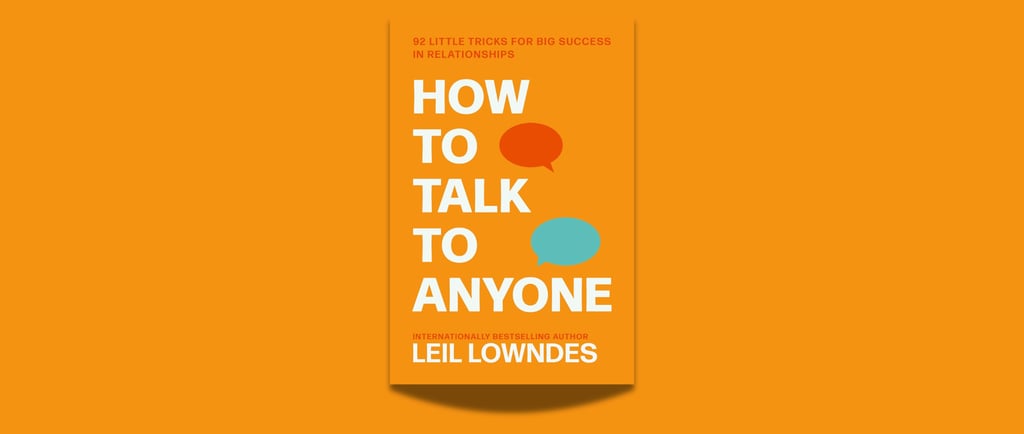
Two people can have the exact same conversation and walk away with completely different reactions from the room. That's because a single interaction between two humans carries something like 10,000 units of information a second. Words are a rounding error. Our interaction's signals are so complex that no amount of clever phrasing was ever going to be the real lever.
That's the whole game How to Talk to Anyone is playing. Leil Lowndes spends four hundred pages confirming something Dale Carnegie said in one sentence back in 1936: people don't remember what you said, they remember how you made them feel. Everything else in the book is just tactics for that one idea.
You have ten seconds, and none of them involve your mouth
The way you look and move accounts for more than 80 percent of someone's first impression of you. Your body shrieks before your lips can speak. That's not a metaphor, it's a timing problem. Emotional reactions fire before the brain has finished processing what caused them. So the posture, the pause before your smile, the way you hold eye contact—that's the actual conversation. The words come after, mostly to confirm what the body already said.
The delayed smile is the clearest example. Flash it the instant you see someone, and it reads as reflexive, the same grin you'd give anyone. Hold for a beat, let it build, and it reads as earned. A slower smile has more credibility because it looks like a reaction to this specific person, not a default setting.
Small talk was never about the talk
Small talk is not about facts or words. It's about music, about melody. That reframes the whole exercise. You're not trying to say something interesting; you're trying to match tone. Take a voice sample of the other person before you open your mouth. Are they buoyant, bored, checked out? Match that first, and the content of what you say barely matters. Almost anything is fine as long as it isn't a complaint—open with something negative and you get labelled a complainer before the conversation even starts.
Echoing works the same way. Repeat someone's own word choices back to them, and it creates rapport that feels involuntary, because it is. And once you flip your default pronoun from "I" to "you," you get the same effect from a different angle. Starting sentences with "you" pushes the other person's pride button and saves them the work of translating your sentence into terms that matter to them.
Compliments are a skill, not a reflex
The instinct to deflect a compliment is one of the most common social mistakes, and I'm working on catching it in myself. When someone says something nice, the boomerang move is to send the good feeling back rather than wave it off. "Oh, that's so nice of you, I appreciate it" lands completely differently than "Oh, it's nothing." One insults the other person's judgment. The other rewards it.
The killer compliment has rules attached, and they matter: deliver it in private, make it specific enough to be credible, and never give the same person more than one every six months. Skip the rules, and you go from generous to obsequious. The tombstone game takes this further, a four-step ritual for finding out what someone is actually proud of in life, so you can hand it back to them later as a compliment they'll never forget you gave.
There's also a greeting worth trying: instead of asking how someone is, just tell them, "You've obviously been well." It skips the small talk script entirely and starts the conversation one level deeper.
The insider move applies to more than parties
Before any big purchase, the pro assumes that because you know a handful of insider terms, you also know the fair price. Learning the lingo of an industry, even loosely, changes how you get treated in it. That logic doesn't stop at parties and dinner tables. It's a general rule for walking into any room where you're an outsider: a little vocabulary buys you a lot of credibility.
Key takeaways
Habits to build
Delay your smile half a beat before it lands, every time you greet someone.
Read the other person's mood before you speak, not after.
Echo back the specific words people use instead of paraphrasing them.
Start more sentences with "you" than with "I."
Boomerang compliments back instead of deflecting them.
Never let "thank you" stand alone. Attach it to something specific.
Learn a little of the relevant lingo before any negotiation or big purchase.
Exercises to try
Build a personal thesaurus: pick five overused words you say daily and replace them, one at a time, over two months.
Run the tombstone game with someone close to you and bank what you learn for later.
Try the greeting "You've obviously been well" instead of the usual "how are you."
Prepare two or three genuinely interesting facts about your hometown so you're never one sentence deep in that conversation again.
Quotes to live by
"There are two kinds of people in this life: those who walk into a room and say, 'Well, here I am!' And those who walk in and say, 'Ahh, there you are.'"
"A big, warm smile is an asset. But only when it comes a little slower, because then it has more credibility."
"Small talk is not about facts or words. It's about music, about melody."
"People don't care how much you know until they know how much you care about them."
How it connects to the Bible
Strip away the techniques, and the whole book is an argument for paying closer attention to the person in front of you than to yourself. That's not a new idea. Philippians 2:3 got there first: "Do nothing out of selfish ambition or vain conceit, but in humility value others above yourselves." Lowndes calls it charisma. The Bible calls it love and says it's actually more fun to give than to perform. Real delight in another person doesn't need a script. The techniques are just training wheels for something Jesus did without ever needing a trick to make it credible.