
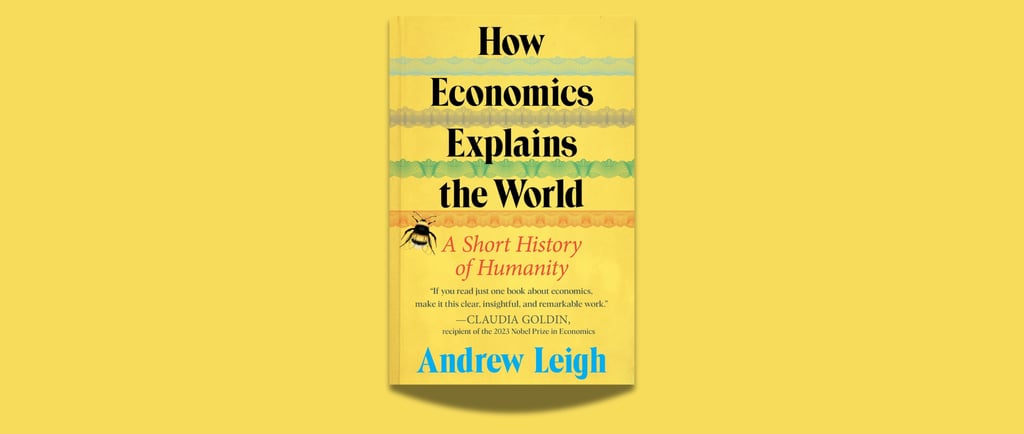
How Economics Explain the World by Andrew Leigh
Economics isn't about money. It's about everything else.
7/17/20264 min read
Geography rigged the game before anyone started playing
I used to think rich countries got rich because they were smarter, harder working, or just better at capitalism. In How Economics Explains the World, Andrew Leigh makes a much stranger case: most of it came down to which plants and animals happened to live on your continent.
Eurasia had wheat, barley, and legumes that stored for months, plus goats, sheep, and cattle that could be domesticated. Africa had bananas and yams that spoiled in days, and zebras nobody could tame. That gap alone explains a lot of what came after. Add in the shape of the continents. Eurasia stretches east to west, so farming innovations spread across similar climates without anyone having to reinvent agriculture from scratch. Africa and the Americas run north to south, which meant crossing entirely different growing conditions just to migrate.
The same logic explains colonialism's uneven cruelty. Where settler mortality was low, like Canada, the US, Chile, and Australia, colonial powers built railways and universities because they planned to stay. Where mosquitoes carrying malaria made settling nearly impossible, like Nigeria, Angola, and Madagascar, the relationship was purely extractive. Disease patterns even shaped which direction the slave trade ran.
And luck can flip on you fast. In 1500, Spain was the wealthiest nation on earth thanks to gold and silver flooding in from the Americas. All that precious metal acted like a government printing too much money: prices rose, exports collapsed, and Spanish manufacturers couldn't compete. Two centuries later, Spain was a backwater. Getting rich by accident doesn't mean staying rich.
Incentives explain almost everything else
Once you accept that early history was mostly luck, the rest of the book is really one idea applied over and over: people respond to incentives, even when their reasons look irrational on the surface.
Henry Ford didn't limit Model T buyers to black because he liked the color. Black paint dried fastest, and speed mattered once the assembly line existed. Gary Becker took the same logic further and applied it to crime and discrimination. Criminals aren't stupid, they're weighing costs and benefits like everyone else. Racist employers pay a real price for their prejudice too: by refusing to hire from part of the labor pool, they end up paying more for the same quality of worker, and competitive markets slowly squeeze that cost out of them.
This is also why migration debates miss half the picture. Migrants aren't just new mouths to feed, they're new muscle and new minds, a source of supply as much as demand.
Tariffs are the clearest modern example of incentives working against the person who imposed them. Trump's steel tariffs were framed as punishing foreign competitors, but the bill landed on American households. Because far more people work in steel-using industries like construction and car manufacturing than in steel production itself, roughly sixteen jobs were lost for every job the tariffs protected. Retaliation from trading partners then cut US export volumes by 10 percent. Trade wars, like real wars, tend to produce more losers than winners.
The same lens works on today's headlines
The book's back half turns this framework loose on current policy debates, and it holds up well. Interest rates are basically the price of choosing to spend today instead of tomorrow, which is why the Tinbergen Rule matters: with one tool, you can only hit one target. A central bank can't fix runaway house prices and low inflation with the same interest rate lever.
The same discipline applies to climate policy. The Stern Review found that spending roughly 1 percent of global income now could meaningfully limit future climate damage, mostly by directing investment we're already going to make toward lower-carbon options. And it applies to your own portfolio: a survey of more than forty top economists, several of them Nobel winners, couldn't find a single one who disagreed that investors do better in index funds, yet most actively managed funds still underperform the market. Kahneman's point about fast, biased "System One" thinking versus slower "System Two" thinking isn't an argument for being a robot. It's a reminder to notice the moments, like an inflated menu price nudging your order upward, when the fast system is quietly costing you money.
Key takeaways
Concepts and vocabulary to know
Opportunity cost: weigh a purchase against the next best thing you could do with that money
Comparative advantage: difference between countries, not raw size, is what makes trade worth doing
Resource curse: a sudden windfall of valuable resources can wreck the rest of an economy
Monopsony: when a buyer, not a seller, holds the pricing power
The Tinbergen Rule: one policy tool can only target one problem at a time
The "iron triangle" of health care: cost, quality, and access, pick two
System One and System Two: fast, biased, instinctive thinking versus slower, more rational thinking
Facts that stuck with me
Malaria and settler mortality rates predict whether a colonial power built institutions or just extracted wealth
Spain went from the world's richest nation in 1500 to an economic backwater within two centuries, undone by its own gold
Not one of over forty surveyed top economists disagreed that index funds beat active management
The 2018 US steel tariffs cost roughly sixteen jobs elsewhere for every job they protected
Global population is projected to peak around 10 billion once fertility drops below the replacement rate, in about a generation
Monopoly was originally designed by Lizzie Magie to criticize land grabbing and monopolies, and she was paid $500 for it while the message got flipped into celebrating whoever wins
Quotes worth remembering
Corruption flourishes when economic power meets crooked politics outside the public eye.
Having a trading partner is not a threat, it is an opportunity.
God is usually on the side with the bigger battalions.
Conceptualists find. Experimentalists seek.
Difference is what makes trade work.
How it still connects to the Bible
The biggest twist in this book isn't economic, it's moral. So much of who got rich and who didn't traces back to which plants grew on your continent and which mosquitoes lived there. Empires didn't rise because their builders were more virtuous. They rose because of a roll of the dice thrown thousands of years before anyone involved was born.
The Bible has been making a version of that argument for a long time: "What do you have that you did not receive? And if you did receive it, why do you boast as though you did not?" (1 Corinthians 4:7, NIV). Swap "grace" for "geography" and Leigh's whole book starts to read like a footnote to that verse.
There's real freedom in that. If wealth, or the lack of it, says less about character than about mosquitoes and continental shape, boasting stops making sense, and so does shame. That kind of unearned gift finds its fullest form in Jesus, who gives freely to people who never could have earned it. That's better news than any GDP chart.